Why We Eat This Way
Butter Chicken: Pehli Baar
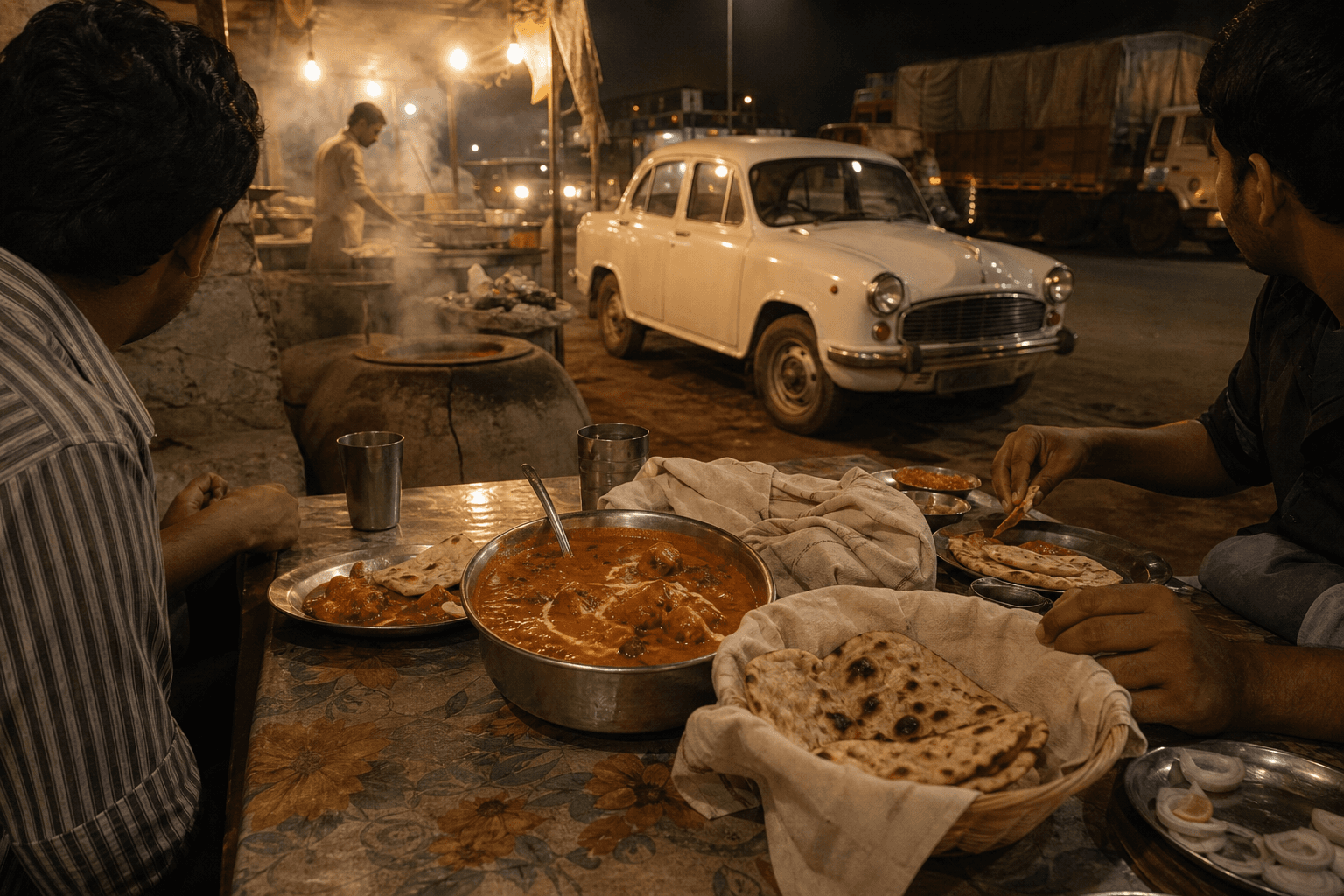
A first taste of butter chicken on GT Road — late night, white Ambassador, tandoori roti, and a dish whose richest story begins with leftovers.
There are foods you hear about before you taste them.
In the late 1980s, in Jalandhar, butter chicken was still that kind of food. Not common. Not delivered. Not the thing that arrived in a foil container at your door on a Tuesday. It existed somewhere — in certain restaurants, in certain cities, in conversations where someone had been to Delhi and came back talking about it the way people talk about something they want you to understand without being able to fully describe.
Word of mouth. That specific place on GT Road — Chik Chik House. You should go.
So when the 21st birthday arrived and someone managed to arrange a car — a white Ambassador, large and slow and exactly right for the occasion — the decision made itself.
Nothing about that drive felt ordinary.
The Ambassador sat four or five comfortably and felt like a different category of vehicle from anything any of them usually traveled in. White. Wide. The dashboard carrying a small box of perfumed napkins that nobody touched but everyone noticed. The air conditioning running against the hot summer night outside, the windows up, the cold inside the car a specific pleasure of that era — air conditioning was not everywhere, not yet, and to be inside it while the summer heat pressed against the glass was its own small extravagance.
They felt like kings for a day.
GT Road at that hour had its own atmosphere. Trucks. Dhabas lit up against the dark. The specific freedom of being somewhere past the time you were usually required to be home, in a car that belonged to someone else's father, on a 21st birthday that had earned a specific permission — to be outside late, to drive to Chik Chik House, to eat butter chicken.
The smell of tandoor smoke arrived before the restaurant did.
Butter chicken. Tandoori roti. Not garlic naan — tandoori roti, the kind that comes in a basket wrapped in cloth, slightly charred at the edges, soft inside, made for exactly this.
"The something that is hard to name is: the first time."
The order went in.
What arrived was not what had been expected.
Not because it was different from the description — because description had not been adequate. The colour first: that specific deep orange-red, the kind that has butter moving through it in a way that changes the light. Then the smell — tomato and cream and something underneath that was the tandoor, the char of the chicken having been cooked one way before being finished in another.
The first bite was the thing.
Almost melted. That is the only way to describe it and it is not quite enough. The chicken had been marinated and cooked in the tandoor until it had its own character — slightly smoky, slightly firm — and then it had been taken apart and put back together in a gravy that was rich without being heavy, spiced without being sharp, the butter doing something to the texture that made every bite feel like it was asking you to slow down.
Nobody slowed down.
The roti went in. The gravy came back on the roti. The roti went in again.
Ordered twice. Pocket money running its calculations in the background. Would have ordered three times if the mathematics had allowed.
The story behind butter chicken is a Partition story.
The most repeated version begins with Kundan Lal Gujral, Peshawar, and Moti Mahal. He ran a restaurant there and the tandoor chicken he made had already made a name. When Partition came in 1947, he left with what he could carry — himself, his knowledge, and the recipes that existed in his hands rather than on paper.
He rebuilt Moti Mahal in Daryaganj, Delhi.
The butter chicken came from necessity. Leftover tandoori chicken. A gravy made to use it up — tomatoes, butter, cream, the spices that balanced them. Not a planned invention. A practical solution to the problem of unsold food the night before. The gravy was forgiving and the combination was extraordinary and people kept ordering it until it became the thing the restaurant was known for.
A man displaced by Partition, rebuilding in a new city, solving the problem of leftovers.
That is one of the stories behind how butter chicken became butter chicken.
That place on GT Road was not Moti Mahal.
But the butter chicken it served carried the same logic — the tandoor char underneath, the gravy built over it, the specific combination that had traveled from Daryaganj outward until it reached restaurant lanes along GT Road, where young men with borrowed cars and birthday permission could taste something they had only heard about.
By then the dish was already decades old.
It didn't feel like history. It felt like butter chicken at Chik Chik House at midnight, in a white Ambassador that still smelled faintly of perfumed napkins, with friends who were laughing about something that can't be remembered now, with roti in one hand and the knowledge that this — exactly this — was worth the drive.
That taste stays.
Not because butter chicken is rare anymore. It is everywhere now. Every restaurant, every delivery app, every occasion and non-occasion. The foil container that arrives on Tuesday. The version that is too sweet or too thin or missing something that is hard to name.
The something that is hard to name is: the first time.
The specific first time — Chik Chik House, the late hour, the 21st birthday, the white Ambassador, the air conditioning against the summer night, the tandoori roti that was not garlic naan, the ordering twice and the wanting of a third.
Food memory works like this. The taste becomes attached to everything around it — the friends, the hour, the specific quality of being exactly that age and exactly that free and exactly that far from the ordinary Tuesday.
Butter chicken is now ordinary.
That night was not.
Historical note
Butter chicken's origin is disputed. The most widely told versions connect it to Moti Mahal, Peshawar, Partition, and the later Delhi restaurant in Daryaganj. The Gujral family credits Kundan Lal Gujral and a sauce made to revive drying tandoori chicken, while the Daryaganj/Jaggi family disputes sole credit and links the dish to Kundan Lal Jaggi at the Delhi restaurant.